- Review
- Best
- Tankless
- Tank-type
- Heat Pumps (Hybrids)
- RV Water Heaters
- Gas
- Electric
- Pool Heaters
- Solar
- Bosch
- Navien
- Noritz
- Paloma
- Rinnai
- Takagi
- American
- AO Smith
- Bradford White
- GE
- John Wood
- Reliance
- Rheem
- Richmond
- Ruud
- State
- US Craftmaster
- Hydronic Heating
- Troubleshooting
- Maintenance
- Parts
- Buy on amazon
- Sitemap
- What's New
- Privacy
- Disclaimer
- Contact
How to Properly Vent a
Gas Water Heater
Learn and explore tips on how properly to vent a gas water heater and safely remove exhaust gases to the outside atmosphere.
A professionally installed venting system is important for all gas water heaters so they can operate safely and adequately remove products of combustion and water vapor out. To answer the question; how to properly vent a gas water heater, use the checklist below, which provides the answers for:
Need professional help with your water heater?
Get free quotes today!
In this article
- How to find the best location for a water heater
- How to ensure proper combustion, air supply and ventilation
- Vent pipe system types
- Chimney connection
- Using vertical exhaust vent
- Inspection
- How to test if the venting is installed correctly
- Common problems with the improper venting
Location
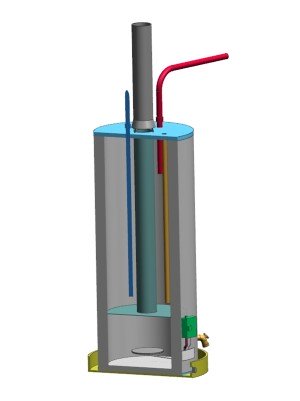 Gas water heater
Finding the proper location and installing a gas water heater is very important as the proper venting provides better heating performance and safer operation.
If you don't know how to vent a gas water heater properly, consult local or national plumbing codes, and check the manufacturer's instructions.
Also, keep in mind that combustion and ventilation requirements will determine where the unit will be located; if the area is confined, unconfined, or your gas water heater is located inside the small rooms and closets. You can also call a professional to do it for you or get a few free estimates from local plumbers by filling out the form.
Confined areas are considered as areas with less than 50 cubic ft. for every 1000 BTU of the total input for gas-fired appliances. Lots of air has to be provided for water heaters located in confined spaces or small enclosures. Two permanent openings are needed for normal venting, one 12" of the top and one 12" of the bottom of that enclosure. The size of the opening is determined by the total BTU input of gas-fired appliances inside that room.
If the air is supplied from the adjacent room, the total volume of these rooms has to provide enough fresh air for combustion and ventilation.
If the air is coming from the outside, it can be transferred directly or using vertical and horizontal ducts, which should be with the same cross-sectional area as the free area of the opening.
For an unconfined space, or open area, indoor air is used for combustion, and the requirement for proper venting is a minimum of 50 cubic feet for every 1000 BTU of the total input of all gas-fired appliances located there.
A water heater vent system and air supply requirements are as described, and it is essential to locate the heating unit as close to the chimney and venting system as possible. The venting system must be able to run from the water heater to the exit with minimal length and elbows.
Tips on combustion air supply and ventilation
- Proper clearances from the water heater must be maintained to allow unobstructed airflow to the unit.
- Provide openings for the air to enter and exit the area, to vent a gas water heater correctly.
- The gas heater's venting windows should have the required size, per water heating manufacturer instructions and codes.
- The fresh air should not be taken from areas where the negative pressure is from devices like exhaust fans, furnaces, dryers, or fireplaces.
- The fresh air should be free of corrosive elements and flammable vapors. The warranty might be voided.
- The venting pipe should be the same size as the openings.
- Do not block the base of the heater and draft hood with the insulation blanket or any other obstruction so that the air can enter the heater chamber.

Is vent pipe system discharging gases safely?
Ensure proper drafting at the draft hood on the top of the tank-type atmospheric water heater. If there is a problem with the correct venting, check the following:
- Is the draft hood correctly installed?
- Is the flue baffle positioned in the flue tube?
- Is the venting system correctly sized?
- Is the venting pipe system done per codes and standards?
- Are all the vent connectors securely fastened and supported correctly?
- Any there any restrictions or obstructions in the vent system?
How to properly vent a gas water heater with a chimney connection
For the proper venting products of combustion the chimney has to be clear and free of any obstructions and, according to the codes. The chimney has to be certified for this purpose.
How to properly vent a gas water heater? For the adequate connection to the chimney, follow the next requirements:
- Install a connector above the extreme bottom of the chimney.
- The connection must be firm and sealed to prevent the vent connector from falling out.
- Do not extend the vent beyond the edge of the chimney.
Using the vertical exhaust vent
According to the manufacturer's instruction, atmospheric gas water heaters with vertical venting must be installed with the UL-listed type B vent pipe. The vent pipe must be terminated in a vertical position with a listed cap only, and it can be combined with the chimney as long as the proper draft is established.
How to properly vent a gas water heater? The recommendation is to follow codes, standards, manufacturer instructions, and tips provided here.
For example, a 90-degree elbow installed on the top of the water heater draft hood can reduce the efficiency of vents by 50%. This is why it is important to allow a rise of ten vent diameters off of the top of the unit and before the first elbow.
Inspecting the venting system
Due to carbon monoxide and fire hazards, check the venting system at least once a year.
This is what you should check during the inspection:
- Flue gases may escape if the vent pipe is not installed per instructions.
- A sooted or deteriorated vent system causes the improper venting or leakage of venting gases.
- Rusty flakes at the top of the heater are a sign of corrosion. Acidic water vapor or condensate is the cause of the vent rusting.
- Remove the chemical substances as the vapor may lead to corrosion of the flue.
Testing
Another tip on how to properly vent a gas water heater is to check the draft in the water heater. Let the unit run for 15 mins put a match flame around the relief opening of the draft hood, and if the steady flame is drawn into the opening, there is proper draft. If the flame flutters or is blown out, combustion products are escaping.
Water heaters are equipped with a thermal switch designed to shut off the gas supply when the water heater is exposed to flammable vapor or due to the poor combustion caused by the blocked vent or insufficient combustion air.
Common problems
- If the heater is installed in the confined area and the burner doesn't ignite, or the burner flame is yellow, ensure proper fresh air ventilation.
- If the heater's flue or vent system is blocked, and there is a lack of oxygen, here are the possible problems you might be facing; the burner flame is yellow, and the flame is "lazy," also there is slow hot water recovery, combustion odor, smoking and sooting, or burner flame floats. Unblock and clean the vent pipe.
- Find out more about the pilot outage affected by the improper venting of the gas water heater here.
Related articles
- Failure signs
- Pilot light goes out and what you can do about it
- Water heater burner is not working - repair tips
- Fixing the temperature fluctuation
- What is condensation and how to stop it
- Bulging
- Home
- Gas water heaters
- How to Properly Vent a Gas Water Heater

Popular Articles