- Review
- Best
- Tankless
- Tank-type
- Heat Pumps (Hybrids)
- RV Water Heaters
- Gas
- Electric
- Pool Heaters
- Bosch
- Navien
- Noritz
- Paloma
- Rinnai
- Takagi
- American
- AO Smith
- Bradford White
- GE
- John Wood
- Reliance
- Rheem
- Richmond
- Ruud
- State
- US Craftmaster
- Hydronic Heating
- Troubleshooting
- Maintenance
- Parts
- Buy on amazon
- Sitemap
- What's New
- Privacy
- Disclaimer
- Contact
Solar Hot Water Heaters Buying Guide - Types, Advantages, and Benefits
 Solar-powered water heater
Solar hot water heaters and "green" heating systems are more attractive than ever before because they are more competitive, reliable, using free renewable energy while providing high-efficient operation.
Cost benefits of the solar hot water heaters utilizing "green" technology are better than before. Government tax credits and utility rebates are available, and value is added to your home by stepping further toward environmental protection, renewable energy utilization, and your energy independence.
Need professional help with your water heater?
Get free quotes today!
Either you are making home improvements with the "green" technology or building a new house, solar-powered water heaters can be added to your old heating system and combined with a new system. This is possible due to their installation flexibility.
Note: Renewable energy is green, clean, pollution-free, and protects the environment. So why not use solar energy when it is free.
Solar hot water heaters can be used in any climate, especially if you live in southern regions. Solar water heating may be cost-competitive with natural gas, propane, electricity, and oil, but it depends on your location and fuel prices.
This is why we are writing about solar water heating, panels, different systems, including active and passive systems, how to build a solar water heater, the main parts, interesting books to read, and much more.
In this article:
How solar water heaters work?
Solar hot water systems are simple, reliable, and efficient systems of harnessing the sun's energy for the energy needs of your home; water, space, or pool heating.
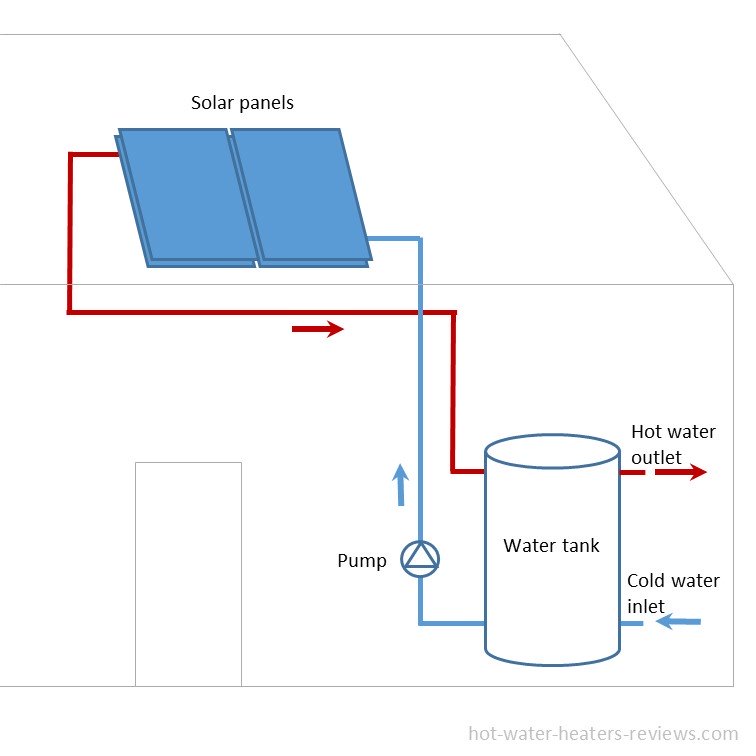
Solar water heaters (SWH) mostly use flat plate collectors known as panels or evacuated tubes mounted on the roof of a house or installed on a freestanding frame (racking system). The purpose of solar collectors is to capture the sun's heat and transfer it further to the air or water.
As the fluid circulates, either naturally or forced by the pump, the energy is directly or indirectly transferred to a storage tank. These tanks are usually located either on the roof or in the utility room and garage.
Tip 1: For solar water heaters to be energy efficient, the storage tank has to have the right size, to match the solar panels' area and family needs.
Tip 2: Collector pipes and storage tanks must be well insulated to reduce heat loss.
Many solar heating systems have a backup heater, so your hot water needs are met even with insufficient sun exposure.
Type of solar water heating systems
Several main types of solar water heating systems are popular and sold today, as the most efficient, reliable, simple, and long-lasting.
- Direct system
- Indirect system
- Active system
- Passive system
- Open-loop
- Closed-loop
- Integral Collector Storage system
- Thermosyphon system
- Drainback system
Direct vs. indirect
When domestic water is heated directly inside the solar collector from the sun's heat energy, we are talking about direct solar water heating systems. We refer to the indirect heating systems, if the water inside the tank is heated by the solar fluid that circulates through the heat exchanger.
If your home is located in warmer climates, you will probably use a direct solar water heating system. The potable water from your home plumbing system circulates directly through the solar collector into the storage tank.
Active vs. passive
With active solar hot water heaters, pumps and controls move hot water from the collector to the storage tank.
On the other side, solar hot water heaters that do not require external energy for their parts (no moving parts) and where hot and cold water circulate thanks to convection and gravity, are called passive systems. A great example is the thermosiphon system.

Open-loop vs. closed-loop
All open-loop systems are direct and active. Domestic water circulates directly through the solar panels/collectors utilizing the circulating pump for this operation. Closed-loop systems are also indirect as the water is heated indirectly; first, the sun heats the solar fluid that circulates through the heat exchanger, where it transfers the heat to domestic water.
The open-loop needs to be drained, when used in cold climates, as the water can freeze up if left in the tubing.
The closed-loop heating system, or indirect, has the antifreeze solution in the pipes. This system has a piped loop of water or antifreeze separated from the hot water supply by a heat exchanger.
ICS
Integral Collector Storage or ICS systems are found as batch and thermosyphon systems, and since they are passive, they do not require pumps. These are built as a single unit, consisted of the collector and hot water tank.
Batch
Batch water heaters are very simple - they consist of a cylindrical tank, painted in black, where water is heated, placed inside the insulated box, and covered with glazing (tempered glass). Domestic water is heated directly inside the storage tank, and it is recommended for mild and warm climates.
Thermosyphon
Thermosyphon systems use natural convection where hot water naturally rises, so the tank of the solar hot water heaters is positioned above the collector without using a pump.
They can also be divided into direct and indirect solar water heating and get direct exposure to the sun or to get the heat from the solar fluid. As long as there is a temperature difference (hot and cold water), water will circulate. According to experts, thermosiphon systems are more effective than batch.
Drainback
Drainback systems are known as active, indirect, and closed-loop solar heating systems. They can be used for water and home space heating and in any climate region except where it is extremely cold. The main advantage is their ability to drain all the fluid out of the collector when the system turns off. That means they require a continuous slope between the solar collector and storage tank.
If you live in a colder climate environment, the drainback solar water heating system is what you want to use. Water in the collector and pipes drains into an insulated tank each time the pump shuts off. This is a safe way of removing water when not collecting solar heat and preventing freezing.
Antifreeze systems - pressurized glycol
The antifreeze or pressurized glycol system is used if the continuous fall is not possible, like with the drainback systems. With the pressurized system, piping can go in any direction without concerns. The fluid used to absorb the solar heat is the mixture of water and antifreeze (propylene glycol due to low freezing point and lack of toxicity). The mixture circulates from the collectors through a pipe coil in the solar tank and then is pumped back through the collectors.
Main parts
- Collectors
- Support structure
- Storage tank except for batch systems
- The pump
- Thermal expansion tank
- Controller
- Freeze protection
- Other safety features
Solar collectors are designed to collect the heat from the sun. As can be seen in this article, there are several types; unglazed and glazed solar panels, evacuated tubes, and concentrators.
Advantages
- Solar hot water heaters utilize free, renewable solar energy.
- Since solar water heating systems utilize free solar energy, they can supply up to 50% of the energy needed for your home and, therefore, greatly reduce the heating costs (depends on climate conditions, water use, and others).
- Some heaters do not require electricity to operate.
- It can be used directly to heat the swimming pool.
- Easy to maintain.
- Solar water heating is a reliable and effective way of heating.
- Government incentives for using green energy.
- Increased energy independence.
- Provides a cleaner environment by reducing greenhouse gases.
Disadvantage
- Higher start-up cost than electrical or gas heaters.
- High installation cost.
- With the lower temperature, the efficiency drops.
- It has to be supplemented by other fuel sources.
- Due to the small pipe size inside the collector, it is subjected to mineral buildup.
Summary
What is common for all types of solar water heating systems is that they depend on sun exposure and solar energy usage.
That is why it is vital to know the basics, such as the solar altitude angle, to orient the collector at the correct tilt angle. For example, solar collectors are most effective when the surface of the panel is normal (perpendicular) to the sun's rays and south orientation.
If you would like to know more about collectors, evacuated tubes, batch systems, how to build an SWH system, click on the provided links.
Related articles
Get HELP on your solar water heater project here!
- Solar types
- DIY design and build tips
- Build a solar water heater
- Problems and troubleshooting
- Swimming pool solar water heater
- Solar panels
- Passive systems
- Active systems
Leave a Comment!
What Other Visitors Have Said
Hot water issue with a solar tank 
does calcium inside a solar hot water tank cause a reduction in hot water production when the tank is being heated during the night by the electric heating …
DIY and how to choose the right size of a solar water heater?
I am planning to build a solar water heater and would like to know your opinion about the approximate size of the storage water tank and solar panels. …
Using solar water heaters in north of Ontario
Hi, I live in the northern part of Ontario, Canada and I am not sure can I use solar water heater to heat my domestic water. Can a solar water heater replace …
How long will solar water heaters last?
Compared to electric, how long will solar water heaters last?
What happens when solar panels malfunction or die?
Solar water heater savings
Find out how to save on water heating when using the solar water heater.
Solar Electric Water Heater Not rated yet
After much indecision and uncertainty I decided to get stuck and finally build my very DIY solar water heater. I set out to the hardware store with great …
Active Direct Solar system not circulating correctly Not rated yet
I have a DIY Active open loop solar water system which comprises of following:
1. 20 58mm Evacuated tube collector
2. 145 litre Hot water cylinder …
Need professional help with your water heater?
Get free quotes today!
- Home
- Solar water heaters

Popular Articles